


Twenty programs, cryptic symbols, and everyone still washes with the same two
A washing machine cleans reliably these days. The complicated part is getting there: choosing the right program. Modern machines have sixteen to twenty of them, with names like "Eco 40-60" that almost nobody can decode. So most people stick to the same two or three and leave the rest untouched.
The strange thing is that the hardware is already smart enough. Many machines already measure load size, soiling, and fabric type, and dose the detergent automatically. What's missing isn't the sensors, it's the layer above them that turns this knowledge into a decision you can follow. The machine has grown smart at carrying out a wash, yet stayed blind to what it is actually washing.
That was the question driving this project: what does the interface of a washing machine look like when the machine itself holds the knowledge about fabrics and programs, and brings you along instead of taking over?
For everyone who washes without wanting to become a textile-care expert
This machine is for people who want to treat their clothes well but have no interest in decoding care symbols or studying program lists. The voices I went through in user forums while researching the concept all sound similar:
"My machine has sixteen programs, but I honestly just use the same two or three. I have no idea what 'Eco 40-60' or 'Mix' actually means for my clothes."
"The manual is eighty pages long. I just want to wash my clothes without needing an engineering degree."
"Those tiny symbols on the care labels might as well be hieroglyphics. I've ruined so many things because I guessed wrong."
"Cotton, Cotton Eco, Cotton 20°, Easy Care, Mix… I just want one button that says: wash my everyday clothes properly."
I've used the same handful of programs for years, not because the others are worse, but because I was never sure what they actually do.
From pen and paper to a reasoning model, in a single workday
I started from a single assumption: a camera with a macro lens sits in the loading area and recognizes each item as it goes in, its material and color. I sketched the flow on paper first, the way I almost always work, then built a clickable base in Figma and turned it into a plain UI. The central rule emerged quickly: the most delicate item sets the terms for the whole wash. A wool sweater in a load of cotton pulls everything down to 30 degrees, because wool felts otherwise, and that can't be undone.


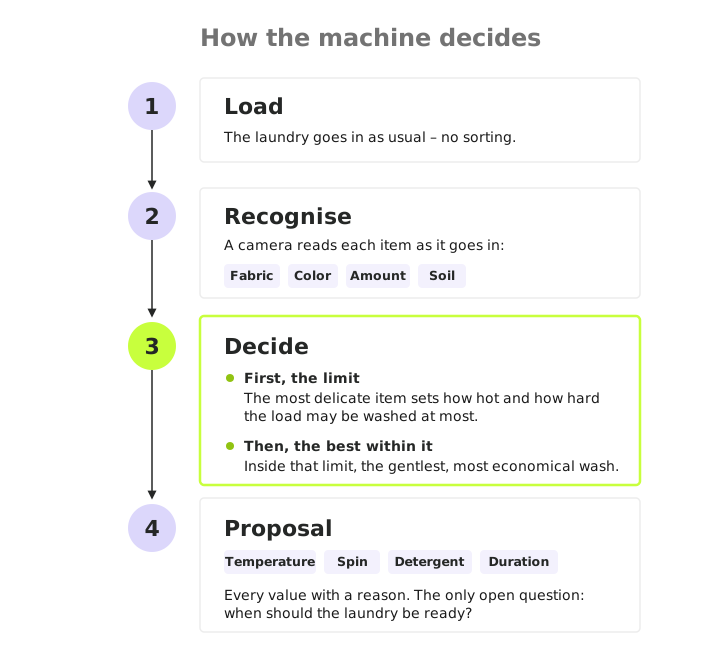
How the system decides runs across two separate layers. Perception recognizes material, color, and soiling through the camera and works, as neural networks do, with a degree of uncertainty. The decision, by contrast, follows fixed rules rather than a learned model, so it stays verifiable. It runs in two steps: first the most delicate item sets the hard limits for temperature and spin speed, derived from the care symbols under ISO 3758. Within this permitted range, the system then optimizes for low wear and energy use. Only one decision is left open, the one no sensor can make: when the laundry should be done. The diagram shows this sequence using a wool sweater as the example.
A prototype that makes the reasoning tangible
What came out of it is a design concept and an interactive reasoning explorer. Laundry items are placed into a simulated drum, and the temperature, spin speed, program, and the reasons behind them change live as the load changes.
 Temperature
 Spin speed
Three cases cover the logic. A cotton load runs at 40 degrees; adding a wool sweater drops it to 30 degrees and 600 rpm, with the line "without it, 40 degrees would be possible"; a black sock leaves the temperature where it is and instead triggers a warning to separate it out. The concept and prototype came together in a single workday, the UI in Figma, the explorer as HTML with simulated recognition.

What's missing and what I'd do differently
The camera recognition has its limits. Throwing three items in at once can overwhelm it, which calls for re-classification with a visible confidence status rather than a silent assumption, and the same goes for washed-out or missing care labels. More complex use cases are still open, like setting a specific finish time, delaying the start, or washing sneakers, and a camera plus the computing power in every drum raises the unit cost.
The UI is at concept stage too, not yet worked out in detail; there wasn't time here for a finished visual design. It also remains open whether the machine should learn from my habits. My current position is no, because reliability comes before personalization.
Frequently asked questions
How long did the project take?
The concept and interactive prototype came together in a single workday. I had gathered the research on pain points and the competitive landscape beforehand, with the help of Hermes Agent, across European user forums.
Which tools did you use?
Pen and paper for the first user flow, Figma for the UI design and the clickable prototype, and HTML with JavaScript for the reasoning explorer. The recognition in the prototype is simulated, there's no real computer vision behind it, which wasn't needed to prove the concept.
Does the concept invent a new washing technology?
No, and that's deliberate. The sensors for load size, soiling, and fabric type already exist in today's machines, as does automatic dosing. The concept works one level up, at the interface that turns existing sensor data into a decision you can follow. It's UX work, not mechanical engineering.
What about the camera and privacy?
The camera looks only into the loading opening; the space beyond it stays out of frame and out of focus. It's visible, its status is readable from a light ring, and it can be switched off physically. Processing happens on the device, only metadata leaves the machine, never images.
Could this transfer to existing manufacturers?
In principle yes, because it builds on sensors that are already there. The interesting strategic angle is the aging population: remote starting already exists today, but blind. Only load recognition makes it responsible to start from a distance, and that has long been a board-level topic at the major manufacturers.